Norfolk’s Largely Unknown Historic Resistance to a Racist Film Brought to Light
(Note: This essay was originally published in AltDaily)
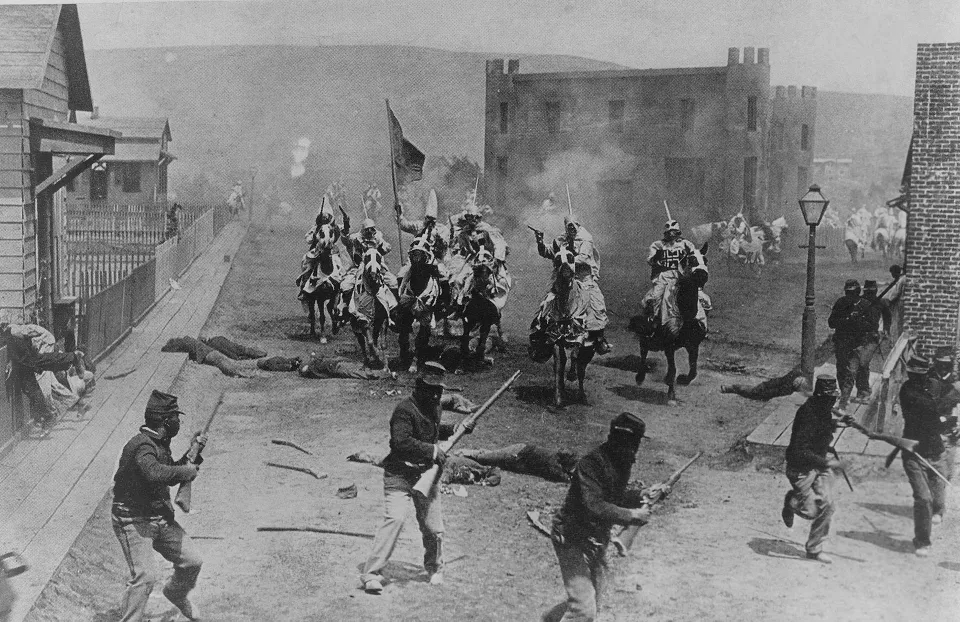 The great contradiction of art is that it can simultaneously convey inspirational beauty and terrible ugliness. Such is certainly the case when considering The Birth of a Nation, D.W. Griffith’s epic silent film released in 1915.
While it can certainly be considered a cinematic masterpiece in which Griffith devised and employed techniques that influenced filmmakers for generations, and still persist today, it also portrayed black Americans in such a vile and prejudicial fashion as to poison the minds of white Americans in ways that persist to this day.
The city of Norfolk played a major role in the story of Birth of a Nation – also in ways both great and terrible – but it’s a role few are probably aware of. Now, in recognition of the 100th anniversary of that film’s release, an ambitious multi-part project titled Birth of an Answer aims to change that. At a point in our history when racial divisions in America have reemerged in ways not seen in decades, the examination of this subject matter arguably couldn’t be more timely.
Spearheaded by the Institute of Humanities at Old Dominion University–the sponsor of this article–and executed with funding and support from many sources, particularly a grant from the National Endowment for the Arts, the project will come to fruition on September 18 at the historic Attucks Theater.
Although at the time it was really just a small sleepy Southern seaport town, it shouldn’t be surprising that Norfolk was chosen as the first Southern city in the country for Griffith to decide to screen Birth of a Nation. After all, the film is an adaptation of The Clansman: An Historical Romance of the Ku Klux Klan, written in 1905 by Thomas F. Dixon Jr.; Dixon had successfully staged an adaptation of the book in Norfolk, which at the time was a virulently racist and segregated community. The city’s white Southern loyalists embraced Dixon’s vision of “The Lost Cause,” and its portrayal of the rise of the Ku Klux Klan as the great defenders of the Southern way of life.
However, it was the book and film’s grotesque and disparaging portrayals of black Americans – perspectives that can still be found permeating throughout racist culture in modern America that generated a backlash, and in many ways can be considered the earliest iterations of the modern civil rights era, including the contemporary “Black Lives Matter” movement. Protests of the film and its contents arose across the country, and many cities banned or censored Birth of a Nation for fear that it might spark racial violence.
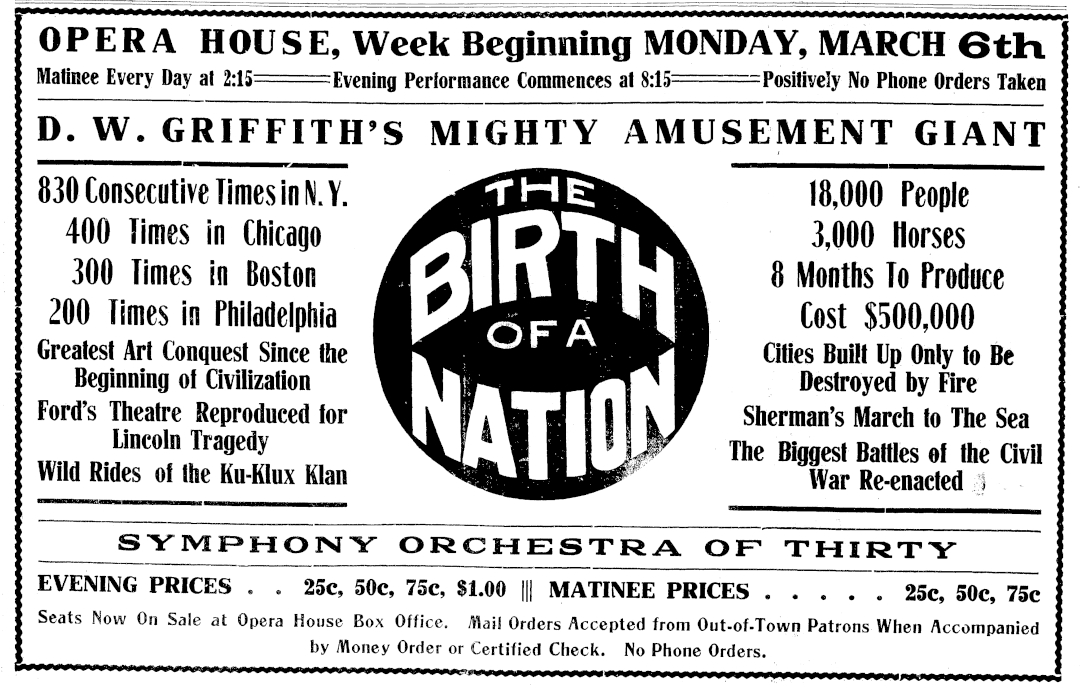 What’s perhaps most surprising is the amount of backlash that emerged in Norfolk – not only from the black community, but by many white residents who, while perhaps not yet ready to fully embrace racial equality, found the portrayals of blacks not only offensive and propagandist, but also dangerous. There was even an attempt by members of the city council in Norfolk to ban the screening of Birth of a Nation on the grounds of it being “highly objectionable,” “lascivious,” “insulting to any audience, white or black,” “calculated to arouse race hatred and possibly race riots,” and as “unfit to be displayed in any city.”
Ultimately, the city council in Norfolk rejected the attempt to ban the film’s screening by one vote, and the film was shown at the Colonial Theater.
Birth of an Answer was conceived as a means to bring Norfolk’s largely unknown historic resistance to Birth of a Nation into the light of day. The project will also document how reaction to that film sparked a backlash across the country, as well as how it gave birth to a largely unexplored genre of moviemaking by black artists, including a film produced at Hampton University after the release of Birth of a Nation that tried to rebut the falsehoods and propaganda initiated and perpetuated by Griffith’s movie.
The coordinator of this project is ODU Associate Professor Ari Santo. In this article he wrote for AltDaily back in March, he said: “Not nearly enough attention has been paid to the ways Black artists, filmmakers, and citizens have responded to the Griffith film both then and now, nor to the national significance of local resistance to the film’s racist vision here in Hampton Roads. Birth of an Answer hopes to address these oversights.”
There will be two opportunities to experience this project, (albeit with one difference). The first opportunity will be on September 18 at the Attucks Theater – a venue which itself came into being largely as a reaction to the screening of Griffith’s film and a desire by black residents of Norfolk to be able to embrace their own art and culture in a non-hostile environment.
The second opportunity will be on September 21 at the Chandler Recital Hall at ODU.
There will be three main elements to the event on each day. The first part will be a screening of African American pioneer filmmaker Oscar Micheaux’s 1920 film Within Our Gates. This screening will be accompanied by a live musical performance of a film score written by acclaimed local composer Adolphus Hailstork, and featuring the Harlem Quartet and guests with members of The I. Sherman Greene Chorale, directed by guest conductor Michael Morgan.
Screen Shot 2015 09 09 at 10.49.20 AM
image | Our Nation
According to a biography of Oscar Micheaux on the website silentera.com, Within Our Gates was “a rebuttal to D.W. Griffith’s Ku Klux Klan propaganda of The Birth of a Nation (1915).” It goes on to say that “Within Our Gates remains a poignant indictment of a Southern lynching and the attempted rape of the mixed race heroine by a white molester who turns out to be her father. Here, Micheaux counters and exposes the trajectory contradictions of Klan vigilantism and White America’s fears of miscegenation.”
Micheaux went on to be one of the trailblazers in an entire subgenre of films created for black audiences – another story often underexposed when considering the history of filmmaking in America.
Another part of the program is the world premiere screening of a new short film entitled Our Nation. It’s a fictional account of the response in Hampton Roads to Birth of a Nation. Directed by veteran filmmaker and ODU alumni Derrick Borte, it’s based on a script by David P. Mallin (who also serves as Director of Photography) and produced by Mallin and Monty Ross. It stars Connor Berry and Marsha Stephanie Blake, and was produced by the ODU film program.
The film focuses on the story of a young boy named Douglas and is set in Norfolk, VA in 1915. It largely focuses on his budding love of movies and desire to see Birth of a Nation, billed at the time as the 8th wonder of the world. It addresses the young boy’s disappointment in the film and how it affected him.
As Mallin the screenwriter put it: “It is a coming of age story for the youngster Douglas, and a defining moment for the Chinese couple who find themselves caught between the white/black divide of another culture where they don’t understand how they fit in.”
This film promises to be profound, and hopefully will be available to a much broader audience after the initial screenings.
The culminating part of the program will differ between the two dates. At the premiere event on September 18 at the Attucks Theater, those in attendance will be able to appreciate and participate in a panel discussion with some of the most prominent African American artists involved in the film industry. It will be moderated by Mike Sargent, chief film critic for WBAI Radio in NYC. Panelists include Zeinabu Irene Davis, Michael Swanson, Melvin van Peebles and Tim Reid.
As stated on the event’s website: “Thematically, the panel furthers the event’s focus on establishing links across generations, while addressing how African American artists and filmmakers continue to create works that bear traces of ongoing representational struggle.”
Although some of the featured aspects of the premiere will not be repeated, the encore presentation on September 21 at Chandler Recital Hall will have its own unique element. Instead of the multigenerational panel of filmmakers, attendees will have a chance to participate in a discussion with composer Adolphus Hailstork, who will talk, among other topics, about his score written for the screening of Within Our Gates. They’ll also get to meet and hear from director Derrick Borte about his experience making Our Nation.
The Birth of an Answer project, beyond its pertinence to many of the same issues America sadly still struggles with today, promises to set the record straight about a story that – like so many other aspects of our incredibly rich that eventually come to light – has been largely ignored by mainstream portrayals of our history. It should be considered a can’t miss event by all.
You can learn much more about the Birth of an Answer project, as well as reading much more about the history that inspired it, at the project’s website at BOAAevent.com. It includes biographies about the participants, as well as profiles of all the amazing collaborators and partners who made it possible. You can also buy tickets to either night of the event online through the site.
The Schedule:
Friday, September 18, 2015 at the Attucks Theatre
7:00-7:30 African American filmmakers poster exhibit on display lobby of Attucks Theatre
7:00-7:30 I. Sherman Greene Chorale perform spirituals in lobby of Attucks Theatre
7:30-7:45 Introductions
7:45-8:00 debut Our Nation
8:00-8:15 transition
8:15-9:30 Within our Gates
9:30-9:45 transition
9:45-10:30 multigenerational panel
Monday, September 21, 2015 at Chandler Recital Hall
8:00-8:30 Discussion
8:30-8:45 Our Nation
8:45-10:00 Within Our Gates